Why Play is the Work
There’s a moment I see all the time.
A parent is watching their child - maybe stacking blocks, maybe lining up cars, maybe pretending to be a dog for the 400th time - and they lean in and ask, “But they aren’t playing the way they’re supposed to.”
Sometimes they don’t even ask it out loud. I feel it in the pause. In their urge to redirect. In the quiet almost unspoken guilt that maybe they should be doing something more.
More structure. More academic learning. More… productivity.
But here’s the thing that often gets missed:
Play is the work.
Not a break from learning. Not a warm-up before the “real” stuff. Not a reward for finishing something more important.
It is the thing.
When children play, they are doing the most complex, integrated work their brains and bodies are capable of.
They are experimenting with cause and effect (“What happens if I knock this over?”).
They are building motor plans (“How do I climb this safely?”).
They are practicing language (“You be the baby, I’ll be the mom”).
They are processing sensory input (the crash, the spin, the squeeze, the rhythm).
They are working through emotions (fear, control, mastery, connection).
And they are doing all of this on their own, at once, at their own pace.
No worksheet can replicate that. No flashcard can compete with that level of engagement.
Because play is not just about what a child is doing. It’s about how deeply their whole system is involved while they’re doing it.
From the outside, play can look repetitive. Aimless, even.
The same puzzle.
The same game.
The same storyline, over and over and over again.
But repetition in play isn’t a lack of progress - it’s evidence of it.
Children repeat what they are trying to understand.
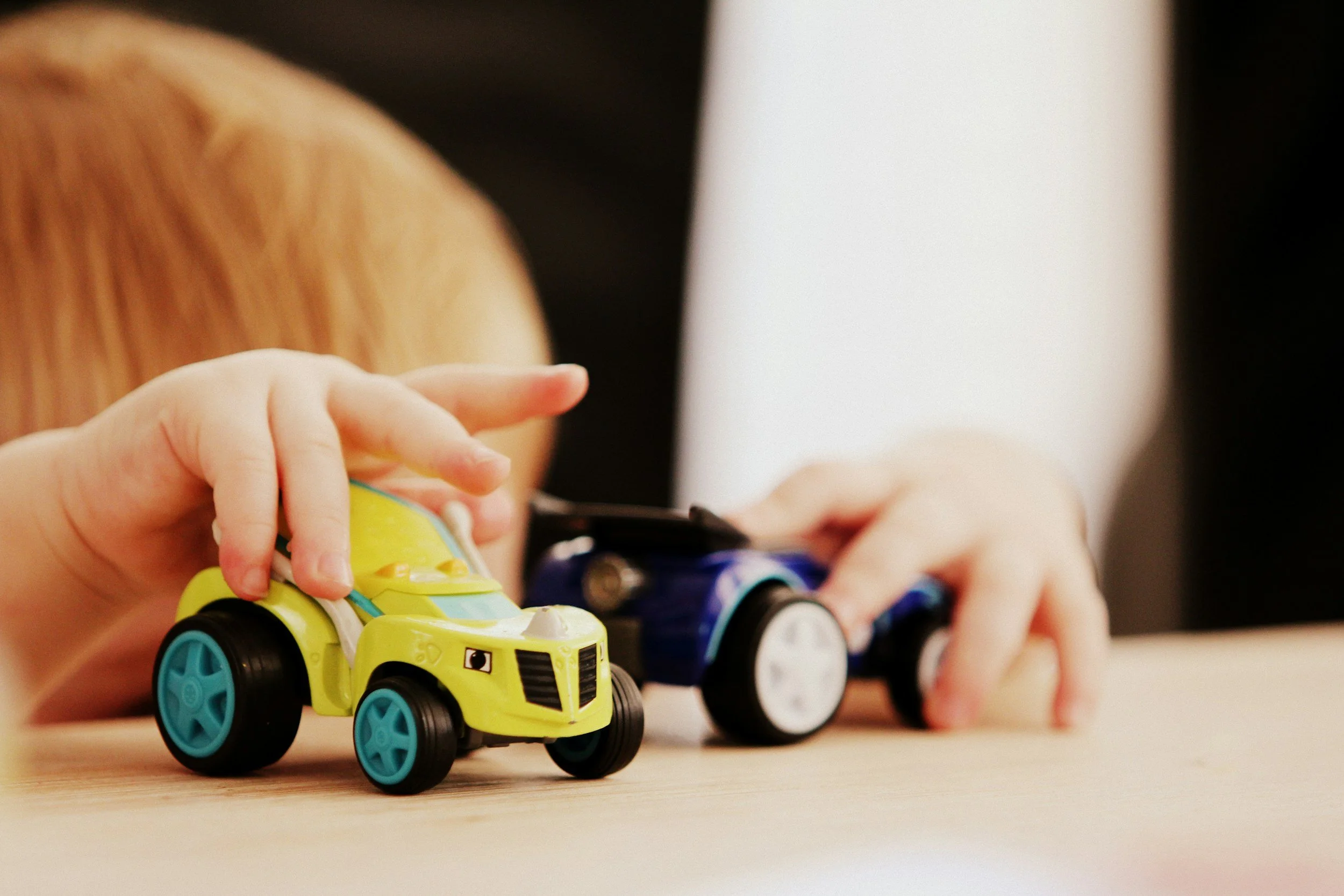
They loop back to experiences their brains are still organizing. They return to movements their bodies are still mastering. They revisit ideas that haven’t fully “clicked” yet.
Adults tend to move on once something is familiar. Children stay until it’s integrated.
That’s a very different goal.
Play also gives children something that structured activities rarely can: control.
In play, children decide:
what happens
how it happens
when it changes
and when it ends
That control matters more than we often realize.
Because development doesn’t just come from exposure, it comes from active participation.
A child who is told what to do can follow directions. A child who creates their own play learns how to think.
They learn how to initiate, problem-solve, adapt, and persist. They learn what it feels like to have an idea and carry it through.
That’s foundational.
And then there’s the part we don’t talk about enough: Play is where children make sense of their lives.
The doctor visit shows up in pretend play.
The new baby shows up in pretend play.
The scary dog, the missed parent, the confusing moment at school. If we let it, it all shows up.
Not neatly. Not in a way that always makes sense to us. But in a way that allows the child to process.
When we rush play, interrupt it, or replace it with something more “useful,” we’re not just shifting an activity.
We’re interrupting meaning-making.
None of this means adults don’t matter in play.
We do.
But our role is often different than we expect.
It’s less about directing and more about noticing.
Less about teaching and more about supporting.
Less about leading and more about joining - carefully, respectfully, and only when we’re invited.
Because when play is truly child-led, it reveals something incredibly important: What the child is ready for, and what they’re not.
Play is information.
Play is practice.
Play is processing.
Play is the work.
So the next time you see a child deeply absorbed in something that doesn’t look impressive from the outside - something repetitive, silly, chaotic, or slow - you can shift the question.
Not: “What are they learning?”
But:
“What are they working on?”
And trust that the answer is: something important.
A Peek Under the Hood
Bodrova, E., & Leong, D. J. (2015). Tools of the mind: The Vygotskian approach to early childhood education (3rd ed.). Pearson.
Ginsburg, K. R. (2007). The importance of play in promoting healthy child development. Pediatrics, 119(1), 182–191. https://doi.org/10.1542/peds.2006-2697
Hirsh-Pasek, K., Golinkoff, R. M., Berk, L. E., & Singer, D. (2009). A mandate for playful learning in preschool. Oxford University Press.
Jean Piaget (1962). Play, dreams and imitation in childhood. Norton.
Lev Vygotsky (1978). Mind in society: The development of higher psychological processes. Harvard University Press.
Mildred Parten (1932). Social participation among preschool children. Journal of Abnormal and Social Psychology, 27, 243–269.
Pellegrini, A. D. (2009). The role of play in human development. Oxford University Press.
